
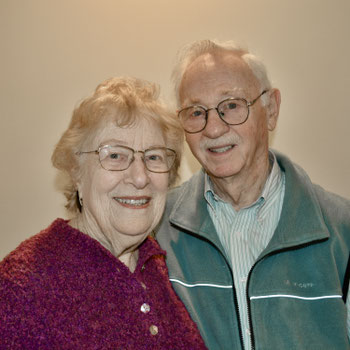
After a 38-year-stint as a professor of physics at the University of Cincinnati, Henry Fenichel now dedicates his life to sharing his story as a Holocaust survivor. He and his mother first hid in their home country, the Netherlands, and then were captured and sent to the transit camp Westerbork, then the concentration camp Bergen-Belsen. The legacy Henry says he wants to leave is telling his story, “because we need to bear witness that it happened.”
Henry (87) and his wife, Diana (86), have also decided to create a monetary legacy.
When asked recently about this choice, to give to Jewish Family Service, Henry said, “Well, you know something about my background, as an immigrant, and the only reason I'm around and alive is because of the support of organizations such as this one. It started way back in the Holy Land, Palestine, before the state was established there, and when we came to the United States, as new immigrants. And so I appreciate what organizations like that do. And now that I can afford to support it, we do it.”
Henry and Diana are not only donors, they continue to be clients of JFS’s Center for Holocaust Survivors. “They're a great help with the official stuff,” said Henry. “Dealing with the Claims Conference has got too high-tech. So someone has to get your photo, upload to a computer, show you're alive and that type of stuff. Kelly [from JFS] is very helpful.”
It was Gail Ziegler, former director of JFS’s Center for Holocaust Survivors, who told Henry that a check from the Claims Conference (Conference on Jewish Material Claims Against Germany) was possible, that he was entitled. Henry had heard about the possibility of reparations as a teenager, and rejected out-of-hand taking German money given his father had died at Auschwitz. But after being on sabbatical in Israel, paid by Tel Aviv University’s funds from the Claims Conference, he became open to the possibility.
When asked her view on why they chose to leave a legacy gift, Diana says, “We have friends who are in [Jewish Family Service’s] Adult Day Services. And I saw how it helped their families so much. Not only the individuals themselves, but their spouses. It really took a load off of their minds and I was very impressed with that.”
Diana also recounted her father’s actions around giving and immigration. “My parents came here as young children from Russia, and over the years, my father would mention HIAS [formerly Hebrew Immigrant Aid Society]—and he kept very good records of all the expenses and all that. And after he died, I was looking through the stuff and I saw that he was making contributions to HIAS, many years later. I think they helped him. He was one of six children, young children, and most of them succeeded reasonably well to very well. But HIAS helped in terms of getting them acclimated to the United States.” One result, she said, was that her father and grandfather became citizens.
When asked what she wants her legacy to be, Diana replies, “As the daughter of immigrants, I respect the new immigrants who come to this country, and I know that they need help when they come.”
There is a very special, rare form of legacy that Henry will be able to pass down. He is one of the survivors chosen to be part of the Nancy and David Wolf Holocaust & Humanity Center’s (HHC) Dimensions in Testimony exhibit, one of only 12 such exhibit locations in the world. In partnership with the USC Shoah Foundation, this exhibit records a survivor over the course of a week, in a way that allows visitors to engage in realistic, one-on-one conversations with a survivor.
“So after this, people ask me, you know, have I written a biography?” Henry laughs. “And I said, no, I haven't written, but now I don't have to anymore. You know, you can come over and ask me questions.”
In closing, Henry reminds the interviewer that HHC sends him out regularly, every few weeks, to the Holocaust & Humanity Center or high schools in Greater Cincinnati to tell his story. “I think that’s your legacy,” says Diana.
Henry agrees: ”Yes, passing on my story.”
Learn more about the Cincinnati-wide Create Your Jewish Legacy program here.
You can also learn more by reaching out to Rebecca Bishop, Senior Annual Giving Officer for Jewish Family Service, at [email protected] or 513-985-2961.
OUR LOCATIONS
Jewish Family Service
9395 Kenwood Road, Suite 100
Cincinnati, OH 45242
Hours: Monday - Friday 9:00 am - 5:00 pm
Heldman Family Food Pantry &
Barbash Family Vital Support Center
3113 Clifton Avenue
Cincinnati, OH 45220
Hours: By appointment only
JFS Help Line: (513) 469-1188
General Fax: (513) 766-3358
Write a comment